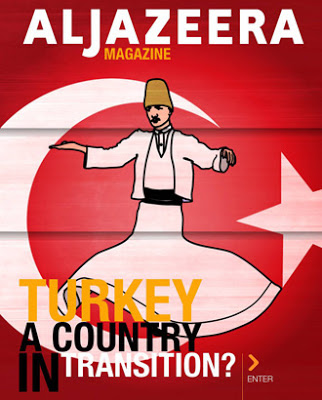
Al Jazeera Magazine, July Issue
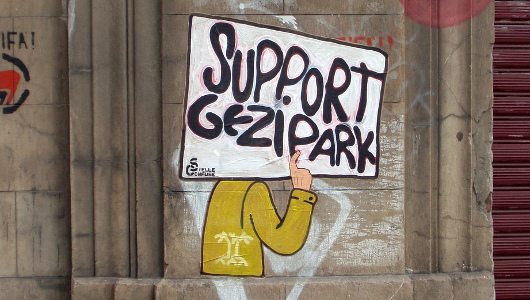
The chronic troubles of Turkish media became visible once more during the initial days of Gezi protests when mainstream television channels chose not to broadcast the developments.
This led to an avalanche of opinion editorials, full of metaphors and personal anecdotes, declaring that there is no freedom of expression and media in Turkey.
Such blanket conclusions seemed to be supported by recent global rankings produced by various groups on freedom of press, in most of which Turkey scored worse than Jordan, Russia, Afghanistan, Zimbabwe, Iraq, and Algeria. The catchy phrase “Turkey jails more journalists than Iran, China, Eritrea and Syria” became a common feature.
Combined with the never ending global panic attacks on 'Islamism' in Turkey, a picture of Turkey became dominant in the international media: under an Islamist government that is finally showing its true colors, Turkey has become worse than ever before.
It has been difficult to agree with such problematic and often political conclusions. While on the one hand the facts of what happened in Turkey last few weeks are clear to see, when put in their context it is also clear that both the Turkish democracy and freedom of media are in a much better place than where they were in 1980s, 1990s and even early 2000s.
Sadly, before we had 'Islamists' in power and Turkey was ruled by 'modern secular Turks', Turkey produced more than 900,000 internally displaced persons between 1980s and 1990s, according to a report by Hacettepe University released in 2007. These were mostly Kurds fleeing from brutal state campaigns to evacuate thousands of villages in Eastern Turkey. They have faced gross human rights abuses with no mention in the Turkish press.
Similarly, discrimination conservative Muslims suffered at the hands of aggressive state intervention in their lifestyles in 1990s and early 2000s never really hit the mainstream media. Thousands of young girls were denied education or forced to remove their headscarves.
In fact, as someone who grew up in Izmir, citadel of 'secular Turks', my entire life was sheltered from knowing what was happening in Eastern Turkey or to conservative Muslims, or why and how Armenians and Greeks disappeared from the city of my childhood.
Just 5 years ago, we could still not mention '1915' in our writings and conversations without a fear of state and widespread public reaction. Now, one can see the word 'genocide' used in articles and book titles.
Until very recently, Turkey saw extrajudicial murders of journalists. Military officials have regularly called journalists into 'briefings', passing out written statements and threatening and intimidating anyone who did not abide by army's redlines.
Between 2002-2008, Turkish media was the battleground for a well orchestrated 'psychological warfare' to topple the AKP government, with daily dose of false and sensational fear mongering. Not a small number of voices who are still in media today were willing and active voices for truly undemocratic calls and attempts then.
Today, even though it is clear that the Turkish government and state wish to influence and coerce press reports and some media outlets willingly or often unwillingly oblige, Turkish media is still full of extremely critical reports on the government.
Any group that is said to be too powerful to criticise, such as the Hizmet movement, are pretty much criticised everyday in all forms of media. In fact, even though television channels did not initially air Gezi protests live, print media was seeing harsh debates and a full range of views on what was happening.
Yet, stating the facts that Turkey has come a long way in the last decade, and that it actually is by and large free, does not mean that where the media is today is acceptable. Turkish media is suffering from a mixture of old and new problems that urgently need to be addressed.
First of these is the strong state tradition. Turkey is a modern nation state, with all the troubles that come with that, including an all powerful state that sees itself as the guardian of the nation, even if and when the nation does not want to be guarded.
Thanks to the privatization policies of Turgut Ozal, Turkey started seeing a break away from the ban on private broadcasting in 1990. Yet, the strong state tradition in Turkey showed itself again with the creation of the Radio and Television Supreme Council (RTUK) in 1994, which sought to ensure that the newly freed media was kept under control through regulations, fines and pressure.
In 2011, AKP government repealed the restrictive RTUK law and adopted a new broadcasting law in line with the EU accession criteria. However, from 2011 and onwards, Turkey also saw AKP government lapsing back to strong state policies.
With historic vote rates, dazzling economic and diplomatic expansion, weakening presence of the military and old elite in politics and state, the loss of EU’s carrot-stick role and utter failures of Turkish opposition parties, AKP found itself as the unchallenged power in the land. This meant that the Prime Minister and the party could pursue any policy and project they want.
Since then, media outlets have found themselves increasingly under pressure to abide within sensitivities of the government. RTUK, has a different political and social outlook and list of ‘red lines’ now compared to restrictive 'secular days', but it is still the good old state stick to keep rowdy media in line.
In issues of national security and potentially risky incidents, the state handling of the fallout continues to be restrictive. The courts have recently issued injunctions to stop broadcasters and media from reporting developments. The most recent two examples related to an incident in which Turkish jets bombed a group of young Kurdish smugglers near Uludere on Turkey-Iraq border and the car bomb attack in Reyhanli, that killed more than 50 people.
However, Turkish media is still loosely divided between fiercely anti or fiercely pro government views and is unhealthily polarised like the rest of Turkish society. This, and impossibility of any government fully controlling media in the age of internet, limit the historic tendencies of strong state policies to filter information, which AKP seems happy to utilise.
The second reason behind the troubles of media in Turkey today is the problematic laws relating to terrorism and procedural weaknesses of Turkish courts. While the exact current number of journalists in jail is not clear, a recent report by Turkish opposition party CHP, “Detained Journalists Report; Turkey, World's Largest Jail of Journalists,” claimed that there are currently 71 journalists in prison.
According to the report, two thirds are arrested under accusations of being members of outlawed Kurdish organizations, and the rest, being members of terror organizations, such as DHKP-C, or members of the organization 'Ergenekon', which allegedly was behind the coup attempts to topple the government.
The extraordinary numbers of arrests last 4 years signal to a larger problem, rather than a mere clampdown on media. Whether in the issue of Kurdish organizations, that saw arrests of more than 3,000 people and not just journalists working for certain Kurdish outlets, or the on-going court cases against coup plotters, we see major problems in terror laws that criminalize expression of non-violent opinions and the wholesale and prolonged detention of suspects throughout the legal procedures.
Turkish journalists also regularly face legal troubles in reporting on-going court cases. Loosely written laws to 'protect' the judiciary from 'influence' in reaching a decision results in accusations brought against journalists reporting courtroom dramas.
These reflect some harsh truths about the state of the rule of law in Turkey. While recent reform packages brought by the government addressed some of these issues and large numbers are now being released from prisons, Turkey desperately needs a thorough judicial reform and a complete revision of terror laws.
The third reason behind the state of media is the dark side of privatisation. While television channels can be a good revenue generating investment, print media is not. The main return of newspapers is the power, influence and chances it grants owners in their other business and personal interests.
A recent report on media freedom, “Caught in the Wheels of Power”, released by leading research organization TESEV in Istanbul in 2012, highlighted the gap in Turkey's economic competition regulations on media ownership.
One key recommendation on this is to address the issue of owners of media companies bidding for public tenders and receiving large contracts from the state, which automatically creates an unhealthy relationship with the state.
The immense economic interests of media bosses put their staff into a precarious position and fear of losing their jobs. Thus, regulations and bodies that can protect journalists from such pressure must be strengthened at once.
Fourthly, the media sector itself has issues to address. Turkish press products are dominated by unhealthy numbers of columns but not investigative journalism. Payments received by these columnists in leading papers can reach shocking levels, while reporters are paid very low wages.
It is not uncommon to see columnists and media members settling personal scores with personal accusations and sleazy attacks on opponents. Looked from international standards, at times, what passes as journalism, reporting and commentary in Turkey seems amateurish and feeble, with notable exceptions trying to do their best.
Current polarization of media as part of the overall conditions in the country means that both pro or anti government media amplify or minimize news and developments according to their own stands.
Lastly, a substantial reason behind the sad state of media in Turkey is the Turkish public herself. Our weak democratic culture and worryingly low expectations from media outlets fuel media malfunctioning.
For example, on any given day, one can see more than a dozen erotic and half naked pictures on the home page of the website of one of Turkey's leading newspapers Milliyet, which scatters news in between spaces left from those pictures.
Given that the level of public discussion, and the parameters of the respectful exchange of views and analytical thinking are rather low in Turkey, most circulated opinion editorials in social media and read online tend to be poor quality quick attacks and polemics against opponents.
These point to a difficult conclusion on the state of media in Turkey. As Turkey is changing and it is becoming difficult for the state to simply control media and flow of information, and as the Turkish public is becoming more aware and demanding of their rights, the Turkish media is still suffering from a wide range of external and internal failures.
Yet, Turkey is not an authoritarian state and does not have the authoritarian control over media that we see in a wide range of countries that score 'better' than Turkey on recent media freedom charts due to variables and data used.
The never before seen widespread condemnation of mainstream media outlets by the Turkish public points not so much to a deteriorating democracy in Turkey, but when put in its context quite the opposite: Turkey is advancing and she does not want to lapse back to where things once were.
What is clear is that Turkey desperately needs a robust and fully free media if it wants to continue its historic leaps forward. The responsibility for this lies with the government to undertake structural reforms and face some bitter truths about its attempts to coerce media.
But, the responsibility also lies with the media outlets themselves to be self critical, and ultimately with the Turkish public to demand more and not settle for mediocre columnists and sensationalism driven products in the market.